Settling on Seymour


Ever since the discovery by the Keno brothers of a rare John and Thomas Seymour card table on the Television show, Antiques Roadshow, in September 1997, there has been unabated interest in the furniture of this father/son team.

This little table, with its crackled, darkened surface, worn feet, and warped top, was acquired at a New Jersey yard sale in 1970 for $25 and eventually sold at auction for $540,000. As antique furniture goes, that’s a pretty spectacular price! And that might be enough to picque ones interest. But there is more. . . .

American furniture in the federal period (1790-1830) adopted many classical elements of both Greek and Roman architecture and furniture. This classical style went through various phases, with elegant proportions, symetrical design, and fine details remaining constant.

The Seymours totally mastered the elements of this beautiful style and created furniture that adhered/followed to the basic characteristics of the classical style, but also celebrated American indepdendence, innovation, and ingenuity. Athough their pieces were often/sometimes inspired by English furniture, they exhibited a free and energetic spirit that set their work apart from that of their contemporaries.

After researching the Seymours on line, looking at several books, tearing through hundreds of photos, I chose a small (10 3/4″ deep x 23″ wide x 21″ high) dressing mirror as PFW’s next Master Class project (scheduled to begin in Febuary 2013). Why a dressing mirror? It’s not the most useful or practical piece for contemporary life/living.

Well, the piece doesn’t “grab” you right away. The first time I saw it left me unimpressed. However, I always came back to the dressing mirror; something always brought me back to it. There was something about the successful combination of clean straight lines and exquisite curves, that intrigued me. And where the use of contrasting veneers could upset the visual balance, on this mirror it worked perfectly. This was a subtle, but sophisticated design; one that took some time to appreciate.

Like most of our Master Classe projecets, this one also has a series of small challenges. There’s a modest and manageable amount of veneering, some inlay and banding, resawing, fine drawermaking and installation, and small carcase construction. All in all, its small size and interesting range of skills makes it  perfect candidate.

Measurements

After deciding on the mirror, I had to develop dimensions in order to build it. I obtained good quality image of the piece and was able to scale it up using an architect’s ruler. Although not exact, I’m sure the dimensions are close.

In the foreground is a leaf of mahogany crotch veneer (for the top). In the background are a full-size drawing, templates for the legs and the shaped apron.

Preparing the veneer

Usually crotch mahogany veneer has to be conditioned before it can be worked. Its often very brittle and prone to cracking and splitting. At the shop we prep it with a solution of water, gylcerin, denatured alcohol, and glue. This solution is sprayed on until the veneer is fairly soaked.

The flattening solution is sprayed on before laying it up in the press.

Then the veneer is laid between 2 pieces of MDF and sheets of newsprint then set into the cold press. This pressing allows the veneer to absorb the softening solution, while the weight and pressure flatten it. The newsprint absorbs the excess water and accelerates the drying.

The "package" of veneer is placed into the press and screwed down for 24 hours.

After 24 hours, the veneer is removed from the press. The package is unwrapped and the veneer is examined for flaws that might show up later.

After flattening, the once brittle veneer can be safely handled.

Now the veneer is supple and soft, ready to be worked.

Mario

Steambending

On Friday and Saturday, 5-6 October, Alan and I will be at Hearne Hardwoods (a premiere retail hardwood yard) for their open house. These things are usually fun for us because it gives us a chance to meet new potential students, catch up with old friends, and flex our “wood working chops”. On this occasion, we’ll be flexing plenty of chops as well as forearms, backs, and biceps. We’re planning on breaking a major sweat.

A completed Comb-back Windsor with curved armposts.

In addition to a running slide show, showcasing examples of workshop classes (blanket chest, Jefferson Lap Desk, Waterbury drop-leaf table), we’re going to be steambending Windsor chair parts. If you’ve never witnessed this woodworking miracle, you’re in for a real treat.

A Windsor is any chair whose various parts (legs, armposts, spindles) are anchored to a slab seat; this type of construction is fast and direct and enabled l8th century chairmakers to produce a finished chair in only a matter of days instead of weeks or months. Building a Windsor chair is an amazing experience with little precise measuring; no complex angles to fiddle with; no fussy formulas to follow.  I’ve always thought of it as liberating; encouraging a woodworker to push his personal boundaries and take a creative stretch.

The steam bent back terminates in a simple, but elegant hand hold.

Steambending is just a part of building a Windsor, but probably the most important one. When bending wood, you’re taking a straight, freshly-cut length of oak, subjecting it to steam then quickly bending it to a curve- without any loss of strength. The only ways to achieve curves without steam bending is to build up a segmented curve with solid wood that would require skillful joinery or do a bent lamination.

Our steam box is made of 6" PVC. The moving blanket helps to retain heat.

Removing a blank from the steam box, you have a few minutes to affect the bend. The quicker you bend the wood, the better it will turn out. However, you must remember this places a great strain on the material and could cause the bend to fail. So the bending motion must be slow and steady, not quick and jerky. The proper technique allows the fibers on the outside of the bend to stretch and those on the inside to compress.

Mario is bending a back around a wooden form. A steel strap supports the bend.

We’ll be bending like crazy during the open house. And with only a few bending forms, we’ll be removing the bent backs from the jig after a few minutes and tying the ends to maintain their curve. Once the curve is achieved, it will keep. And after allowing a couple of days to thoroughly dry, you can build your chair.        Mario

Done: The Monticello Lap Desk

A couple of weeks ago the Monticello Lap Desk Master Class met for the last time; this was the 3rd of 3 meetings.  Each meeting dealt with a particular aspect of the desk’s construction, with homework to be performed between each meeting.  The desk, designed by Thomas Jefferson and built by Benjamin Randolph, appears to be a simple rectangular box containing a single small drawer.  On top of the box are a pair of hinged panels with retractable legs that can be raised to support a book for easier reading; or they can be opened, set at an angle, and used as a writing surface. Its small size and simple design were deceiving; this was a tricky build. In several blog entries over the course of the class, I chronicled the class’ progress, taking readers from the simple milling and sizing of the various parts to the painstaking installation of the hardware.  This project required some ability – and agility – in several woodworking areas and had a little something to test everyone; there was some wood milling, machine-cut joinery, hand-cut dovetails, tiny miters, hardware installation, and drawer fitting.

I think everyone signed on expecting to be pushed (and to push themselves) to new heights of craftsmanship and extend their personal boundaries.  Well, their expectations were exceeded.  Not that anyone shied away from the challenge.  But I think as projects go, this was a real curve ball; not quite what we thought was coming over home plate. And that was the real challenge at the heart of this project:  thinking that building this desk was going to be “a piece of cake; “a walk in the park”; “no sweat”.  This wasn’t an easy project. If anything, this was a woodworking booby trap!  And the sooner a student admitted as much, the better.  For instance: before drawer dovetails could be laid out and cut, the drawer lock had to be selected- to determine the thickness of the drawer front.  With the drawer front thickness figured out, the placement of the drawer stops could be settled.  With the lock chosen, the lock bolt mortise (into the underside of the top) could be cut; all this before they could be glued up. There would be no opportunity to figure things out along the way. This project had to be approached with great care and sober deliberation- before cutting even a single piece of wood, every phase of the project had to be executed in a very particular order.

And it had to look good. Being so small, so precious, this desk would be scrutinized by everyone stopping by for Thanksgiving dinner.  Every loopy uncle and pain-in-the-neck brother-in-law who took high school woodshop was going to put in their 2 cents. This desk had to turn out better than good; it had to leave that brother-in-law speechless and gasping for air.

All the desks, if not completed, are nearly so. There are the unavoidable odd-and-ends to take care of; the final tweaking and tedious fitting of tiny parts to be done; but everyone is almost there. In fact, one student’s desk will be submitted to FWW’s Readers Gallery.  I’ll keep everyone posted on that one.

Well, now that I’m on the other side of the project, I’m happy I built the prototype, taught the class, and even built a second desk along with the class; this was definitely an achievement and I would consider it one of the neatest, cleanest pieces of woodworking I’ve ever done.  I hope my students will eventually feel the same way; right now they’re still trying to recover from the experience.  Now, let’s see what more trouble I can stir up.

Mario

Cutting the lock mortise required great care and sharp chisels.


Slender strap hinges were used to join the writing panels.

Students could choose either red or green baize for the writing surface.


A snug fit and smooth operation were essential goals in fitting the drawer.

The completed writing desk with writing panels raised to support reading materials.


the opened panels provide a smooth and flat surface for writing.

Which would Jefferson have chosen?


Devilish Dovetails and other daring details

A drawer. We don’t give it much thought. Its just a box- with a knob- for stashing stuff. We don’t think about a drawer until it sticks and can’t be opened; or comes apart spilling the contents over the floor. But building a proper drawer isn’t easy, or quick, as we discovered a few weeks ago. In fact, it took the group all weekend to nearly complete a single small drawer.  But what a drawer!

This one is crammed with small, challenging details. Dovetails are tough enough on larger projects using thicker material. On this drawer, the tiny dovetails were treacherous. And it wasn’t just about the dovetails.

These dovetails had to be precise and perfect to withstand close scrutiny.

The miniscule lock and escutcheon had to be precisely installed- before the drawer was assembled, otherwise the tight interior space would prevent later installation. And there were slender, interior partitions and dividers; all neatly fitting into the sides and intersecting smartly.

The small partitions had to die neatly into the drawer front and sides.

Success depended on careful measurements, crisp marking out, sharp tools, and exacting chisel work. The drawer bottom had to be carefully planed down to 5/32”. It’s edges were then “feathered” to 1/8” thickness along 3 sides to slide into a narrow groove cut along the drawer front and sides. When assembled, the drawer box had to be perfectly square, lie flat on the workbench, and not quite fit into the desk opening; well, not initially anyway.

Mario coaches John on his dovetails. They turned out perfectly!

With the completed drawer built just a tad oversize, it was then planed to barely slide into the case. Each attempt to seat the drawer was followed by a few very light plane strokes, bringing it closer to a perfect fit. The box was supposed to slide in easily, with the front lining up neatly with the case, and the lock operating smoothly. This required patience as well as sharp tools and a steady hand.

The completed drawer was built slightly oversize, then planed to a snug, but smooth fit.

A thick-sided, cumbersome drawer wouldn’t work on this piece. It had to be light as a feather, yet strong and square. And it had to almost “play” like a musical instrument, imitating the light, delicate sound similar to that made when tapping a violin.

The drawer contains lots of neat details often found on period drawers.

By the end of the weekend, this part of the lap desk project turned into a valuable lesson in the proper design and construction of a fine drawer. I think that once a woodworker builds a drawer like this, he will never build another fat, clunky one again.


Mario


Thinking big, building small.


A couple of weeks ago we conducted the first session of the Monticello Lap Desk; a design based upon the original made by Benjamin Randolph for Thomas Jefferson. I decided to build one with the class, for a good reason. First, the desk is a pretty neat bit of woodworking; much more involved than one might think, but an impressive piece to have hanging around the shop. Second, it really was essential that I precede the class’ progress, staying several steps ahead of the crowd. That lead gave me time to get comfortable with the project this time around and recall exactly how I performed some of the operations- or to figure out a better way to get something done. There are few experiences more uncomfortable than standing in front of a class, scratching your head, trying to figure out some detail; while they stand there waiting. . . and waiting. . .

How small is small?

Alan and I started with the best mahogany money could buy. Ouch!  After bucking the planks into shorter, more manageable lengths, we stickered the material and left it for a few days before re-sawing it into thinner planks- and stickering the wood again. We wanted to end up with perfectly flat 3/8” panels for the case, so allowed for up to a 1/4” to be removed. Some of the material was re-sawn and then planed to 3/16” thickness (for the drawer sides). Have you ever cut dovetails in 3/16” thick mahogany?

Material for the desk had to be precisely milled to exact dimensions, then stickered and left to "settle down".

Careful, careful.

This desk is tiny, so tiny that any itty-bitty bungle would be noticed.  If a part is cut a hair too short, it’s done over. If a panel isn’t perfectly flat, it’s discarded. The case is only 2 1/2” high and 9 3/8” wide, leaving only 1 3/4” x 8 5/8” for the drawer. That’s not a lot of space into which a smoothly functioning drawer must be built and fitted.

The delicate banding must terminate in a perfect miter- at each corner.

The small case was glued up with a drawer front "place holder", ensuring a square drawer opening.

At this first meeting, the class concentrated on building the case, fitting the end panel; cutting the mortises for both the lock bolt and the drawer stops; making both writing panels, and routing the recess on the back of the lower panel to accommodate the easel. I’m still surprised we got all that done. Everyone did a fine job and got off to a great start.

John carefully adjusting his block plane before cleaning up his mahogany case.

Lesley, Mas-Star woodworker

Next meeting:  Building the drawer.

Mario


Last meeting of Sheraton Mirror Master Class

Sheraton Mirror Master Class

The Sheraton Mirror Master Class got together last weekend to complete their projects, in their last session. Things went smoothly as students laid out the various parts in preparation for a tedious and challenging assembly.  In order to keep the work moving, I performed the more mundane milling of moldings and cap pieces for the students before they arrived for the weekend workshop. Even with that out of the way, there was still lots to do.

The mirror cornice pieces cut and in place.

Adam cleans up the joints before attaching the split turned columns to the mirror frame.

Doreen completed 2 mirrors during the workshop.

The Federal period mirrors of this type had an architectural character, with cornice moldings, projecting columns, and plinths; so there were a lot of parts to create, arrange and keep track of. For the woodworking student, the appeal of this project is that it requires a range of skills. There was a little carving, a little veneering, and a little turning, all kept to a manageable level.  But the most eye-catching thing about the design was the split-turned sections and rope carvings that flank the mirror. The frame is capped with a lively cornice that is punctuated with a number of miters.

Frank carefully pins a cornice return into place.

Once the students completed the frame assembly, Alan and I cut their back panels from thin plywood and distributed the mirror glass. As the students gathered up their tools and packed to leave, We looked over their efforts. I was impressed with their clean and precise craftsmanship.

Dave even managed to install his mirror panels. Nice work.


Horst heads home.

Congratulations to everyone.

Mario

In the old days. . . .

Does anyone remember the old hardware store? You know, the neighborhood shop that sold nails by the pound, chain by the foot, and provided solid advice for almost any home repair problem that was stalling out your renovation project.

On any given Saturday morning, these neighborhood hubs were buzzing with local traffic.  The stores often had old, creaking wooden floors and pressed tin ceilings, and sometimes even hosted a woodburning stove in the corner; walls were lined, from floor to ceiling, with rows of drawers, bins, and cubbies, containing everything from washers and finish brads to screws, bolts, and even iron strap hinges.  And there was barely room to move down an aisle. A store clerk once told me that if a shopper had to move something out of their way, there was a better chance they might buy it.

Every square inch of floor and wall space is covered. If you can't find it here, it probably hasn't been made in the last 100 years.

The “perfume” of sawdust, paint thinner, and paste wax greeted you at the door, along with the whine of the key cutting machine, or the distinct snap of plate glass being cut.  These were places where you caught up on local news; made new friends, met up with old ones; perused the community bulletin board or grabbed a copy of the local paper.  Customers wandered the aisles, poking around, browsing through bins; lingering much longer than necessary to pick up the item they came in for.  And whether it was a homeowner picking up just 2 sheets of 150 grit sandpaper or a contractor buying paint for a whole house, everyone got special treatment; everyone was treated with respect and courtesy.

Overhead is a rack of galvanized wash tubs. I've only come across these at flea markets- going for a lot more.

Many of these places have been replaced by the big box stores like Home Depot and Lowes.  The new stores, slick and shiny, often stress price over quality and staff their stores with “personal” greeters instead knowledgeable, experienced clerks.

Rags sold by the pound. No roll of paper towels will ever replace a tough 100% cotton rag.

At the neighborhood hardware store, they knew you couldn’t produce quality work with inferior tools and materials. To that end, they stocked the best they could find- then sold it at a fair price. The neighborhood dealer also believed in building relationships with his suppliers- and his customers; because good materials were essential to good, lasting work. And if he did right by his customers, they would return. Where else could you go for an 8” stove pipe elbow, plaster washers, or a radiator key. I once found a store that stocked the old TV “rabbet ears” antennae- and that was only a few years ago.

They've got the perfect brush whether you're using shellac, varnish, tung oil, paint, or stain.

Some of these stores are still around in places like Kansas, West Virginia, & Vermont. And I have found a couple in NJ and one in Philadelphia.  They stay open because the proprietors enjoy their work; consider it a big and important part of their lives. They like the pace, the nature of the work, and their customers. One store owner said,”It’s a good feeling when someone comes in looking for a old-fashioned window sash pulley and you can help them out”. But the economics of the business make it hard to keep the doors open much longer. There are no 40 hours work weeks in this business.

Alan dumps a fist full of screws into the bin to be weighed. Here they still sell fasteners by the pound.

At PFW we lament the disappearance of the neighborhood hardware store; the experience, knowledge, and selection they provided won’t ever be matched by any big box outlet- or any online catalog. So if you happen to come across an independent neighborhood hardware store, stop in, say hello- and buy something because they’re disappearing fast.

Mario


Thomas Jefferson: Statesman, gentleman farmer, inventor, & commuter.

   It was over 11 years ago that noted woodworker Lon Schleining’s article on the Thomas Jefferson writing desk first appeared in Fine Woodworking magazine. Wow! FWW pulled out the stops on that one: 8 full pages, full color lead illustration, detailed exploded color drawings, and almost 20 photos. This was a big deal. Like a lot of woodworkers, I’d never heard of the desk before. And like a lot of woodworkers, after poring over the article in FWW, the piece captured my imagination and won me over.

Woodworkers are both amused by the ingenious design and charmed by its diminutive size.

About a year later, on a trip to the Taunton offices in Newtown, Ct, I got the opportunity to examine Lon’s version. Wow again!  There it was sitting on a hall table – right by the exit door; all by its self, no one watching, no armed guards standing by. Tempting, very tempting . . . .

This is a slick piece of woodwork. The lap desk is tiny; closed it measures about 3” x10” x15”, barely larger than a laptop computer. But this petite piece packs a load of craftsmanship. I’m sure Lon’s version (commissioned by the Smithsonian Institution) was designed to overcome the design and construction shortcomings of the original, which I believe was built upon the hasty and urgent request of Thomas Jefferson.

Choice mahogany is carefully milled to precise thicknesses; some as thin as 3/16", then carefully monitored for flatness.

The original was crafted in mahogany by Philadelphia cabinetmaker Benjamin Randolph. The case is a simple box. On one end is a fixed panel that resembles the drawer front at the other end. This compact box features a delicate drawer, made of 3/16” thick material, fitted with a small bail handle, a drawer lock, and very, very tiny dovetails. Fixed to the case by hinges is a pair of wood panels. And beneath these panels is a recessed “H” frame that can be opened and positioned to support the panels at a comfortable angle; either as a writing surface when fully open, or as a book rest when closed. Everyone who encounters this desk is both amused by the ingenious design and charmed by its diminutive size.

Rear case panel is fitted before the case is glued up.

On the original, there were significant cross-grain issues; the case was nailed together; the hardware was hastily installed. I’m sure neither Thomas Jefferson or Benjamin Randolph (the cabinetmaker) ever imagined the desk would survive, let alone become a precious relic. Jefferson commissioned the desk so he could make good use of his time away from home and when traveling between Virginia and Philadelphia while attending sessions of the Continental Congress.

The writing panels are fitted with breadboard ends to ensure flatness.

Since the publication of Schleining’s article in FWW, woodworkers all over the country have rendered their versions of this historic artifact. Online, I’ve seen versions made and presented as graduation and anniversary gifts; some were copies offered for sale; others were made just for the heck of it. The quality ranges from crisp and beautiful to dull and clunky.  Some makers faithfully followed Schliening’s plan, others just winged it; a few thought they were “improving” the design and changed it to a point where it bears little resemblance to the original.

The desk case is glued and clamped with the rear panel in place.

The big question is: Why have so many people built this desk? Why is this small piece so irresistible? And why does it fascinate so many woodworkers? It doesn’t appear to have any practical purpose, so why go to all the trouble?  Well, I’m going to think about that. And I’ll ask those questions of those who stop by PFW to examine my version of the lap desk- or of anyone reading this blog post.

Over the next few posts, I’ll share some notes and photos of the desk I built. It has been a fun and fruitful build. I enjoyed it and learned a few things. Would I do it again? You bet.

Mario


PFW is offering a Master Class in the Spring of 2012 on the construction of the Jefferson Lap Desk. Check the website for additional information and read my blog post “A Visit to Betsy’s House”.  


Turn away

What I notice when watching a real turner is his speed and confidence. The shavings fly off the lathe in streams; small mountains of chips collect at his feet; and beautiful undulating shapes appear before your eyes as if by magic.  Real turners make it look so easy.  I know better.

I’ve never considered myself a woodturner; always thought of myself as a woodworker who turns.  Same with carving, I’m not a carver, I just carve a little. I’ve never shied away from a turning assignment; never declined to build a piece with turned components. However, I hold myself to a high standard and would never incorporate poor quality turnings into anything I was making.

Over the years, I’ve resorted to various tricks and techniques to maintain a high level of quality in my lathe-turned work. Most real turners would frown on some of the methods I practice. But we all take the occasional shortcut. Would I decline a delicious meal because my host used ready-made pasta instead of making it by hand?  Never.

My “turning techniques for non-turners” actually make a bit of sense and my efforts always produce high-quality work as the end result.

Turning a straight cylinder or taper:  After roughing a turning blank to approximate diameter, I frequently turn to my block plane for some help . Turning a really straight cylinder or taper is tough.  The secret is to create a flat surface, without undulations, along the developing form. Experienced turners would choose a skew gouge for this task. But a skew is difficult to control and prone to digging in and ruining the work. Using a smaller curved gouge will leave shallow depressions that reflect the curve of the tool.  By using a block plane you employ a design that allows woodworkers to plane the surface of a board perfectly flat, so the length of the plane directly affects the flatness of the lathe-turned surfaceAdditionally, the plane also controls the depth of cut, same as it does when planning a board. And this simple technique won’t damage your plane.

Using a block plane is a great way to achieve a smooth taper.

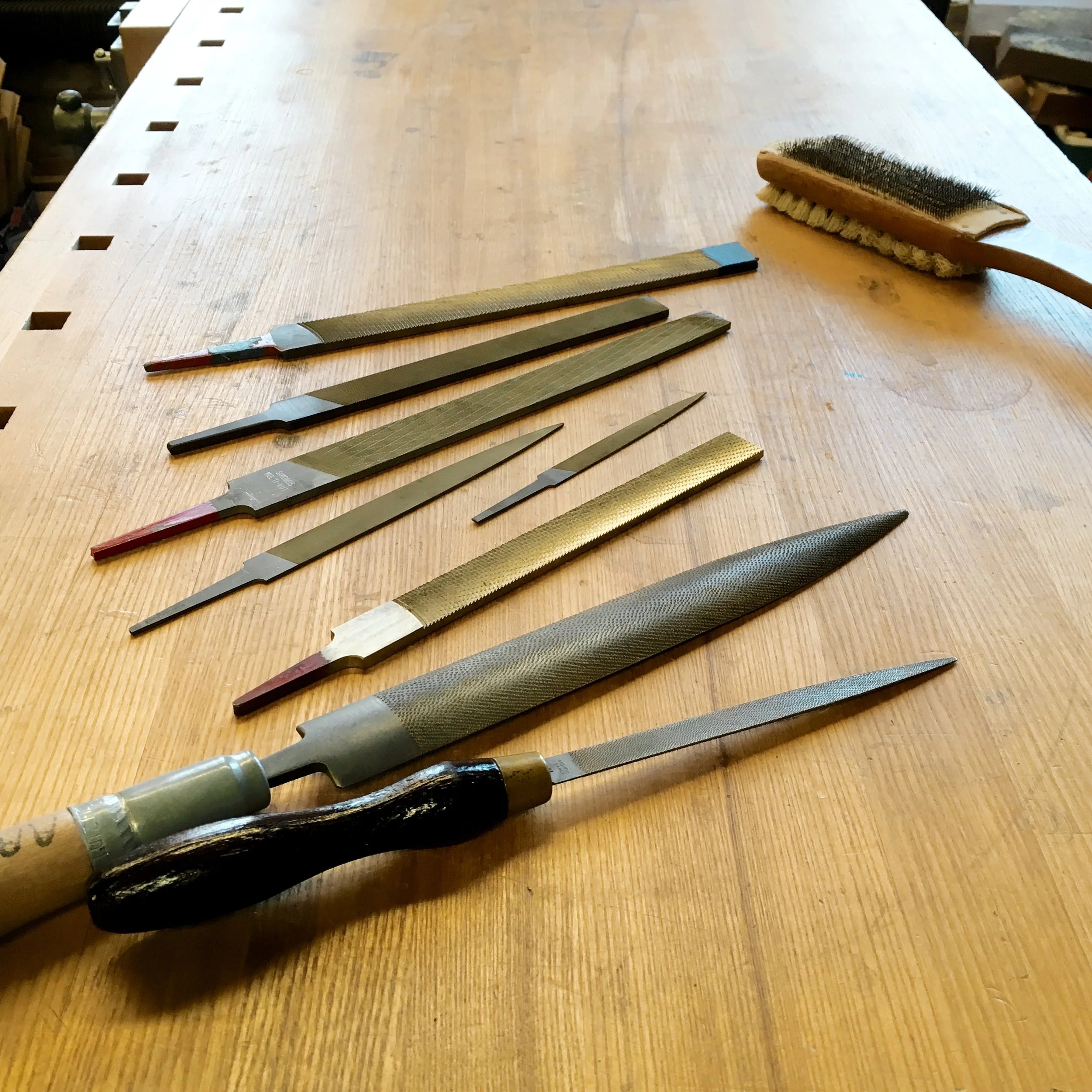
A Grobet file saves the day: I often use a Grobet detail file to work the curves on my turnings. This invaluable double-ended, half-round file tapers at each end; one end is coarse, the other is fine. Don’t let the delicate appearance of this workhorse deceive you. This tool quickly removes wood, leaving flowing curves in its wake. I love it.

use a Grobet file to better shape your forms.

Sanding shapes on the lathe: The best looking rings and reels are those cut to a smooth curve. Bumps, flats, and divots all detract from a good job. Both concave and convex shapes can be cleaned up with complimentary wood shapes, faced with sandpaper.  Another trick is to wrap a dowel in sandpaper and gently press it against the spinning blank to clean up and smooth curves.  Lee-Valley sells sanding rubber grips, in a variety of shapes and sizes, for the same purpose.

A rubber sanding grip neatly shapes a ring

 A hand full of shavings:  After planing, filing, and sanding the work, the final step is to burnish the turnings while still spinning on the lathe. Using a handful of shavings, gathered from the floor, I simply press them to the workpiece. The shavings will leave a pleasant, low-luster surface that’s ready for finishing.

Shavings rubbed against the turning will nicely burnish your turnings

Done: Burnishing your turnings will highlight any rough spots that might require more attention. Here, the turning displays a good-looking, soft-satin surface, ready for finishing.

ready for finishing

Mario


Stick with a little style

A few weeks ago Manish, who is a student at PFW, called to say he’d taken a fall down some stairs and hurt his ankle. Hurt his ankle? When I saw the i-phone photo he sent of his injury, I thought he would never walk again.

Well, with the aid of an ankle brace, Manish is back on his feet – sort of.  But hobbling around with a brace is tough – and very slow.  Manish is an energetic and smart young executive who supervises scores of subordinates and travels all over the country. He’s a very busy guy who can’t afford to lie around while his leg heals. He’s got to be on his feet and on the move. Manish needed to be less of an invalid and more of a man in charge. How could we transform Manish’s condition from one of immobility and helplessness to one of action and accomplishment?

Historically, men of power, wealth and style carried canes. It might have helped them get around, but a cane was also regarded as an essential part of a gentleman’s wardrobe; a symbol of his influence and refined taste. Oscar Wilde carried one, so did the Marquis De Lafayette and Price Albert; the Duke of Windsor had a collection of them.  Manish needed some panache. We had to replace his stagger with some swagger. A walking stick might be the answer.

I suggested the idea to Manish and he jumped on it. This was also a chance to improve his turning skills and get in a little shop time. I made a few of sketches, pulled a couple of walnut chunks for turning blanks, and found a 36” length of walnut, about 1 1/4” square. Perfect.

The idea was to turn a slender staff and top it off with a sculpted handle; attached to the staff with a wedged through-tenon. The project skills weren’t difficult at all. This was a matter of good planning; executing each task in the proper order for the best results, in the least amount of time and with the least effort.

Below are a few shots taken as Manish’s stick took shape. It wasn’t difficult and didn’t take too long. I think we were both pleased with the result. Although it still had to be sanded and finished, Manish tested out the stick. As he wrapped his hand around the sculpted handle and placed his weight upon it, the walnut staff seemed to suit him; standing straight and strong, his confidence and authority were restored. By the time he reached our parking lot, Manish had adjusted his gait to make the most of his new accessory. I could already picture him waving his new cane to hail a Center City cab; entrusting it to coat check clerks at Philadelphia’s finest restaurants; using it to point out local landmarks to admiring colleagues. Manish was his old self again.

Mario


The rough carved handle has been drilled for the staff's through-tenon.


The handle has been glued to the staff. Now the ebony-wedged tenon must be trimmed.

Manish inspecting progress on the carved handle.

A Grobet detail file is used to fair and smooth the handle.

The completed walking stick.