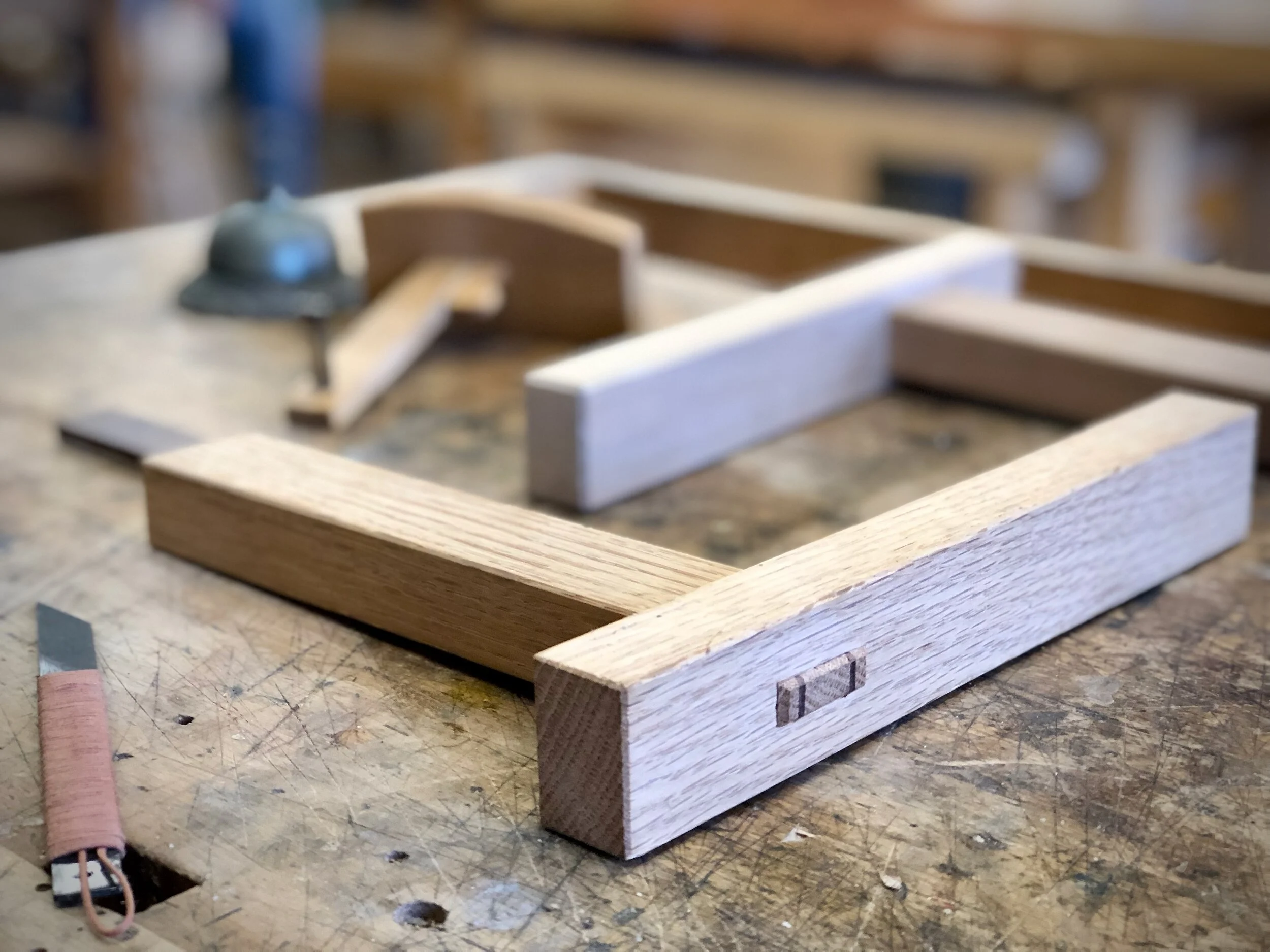
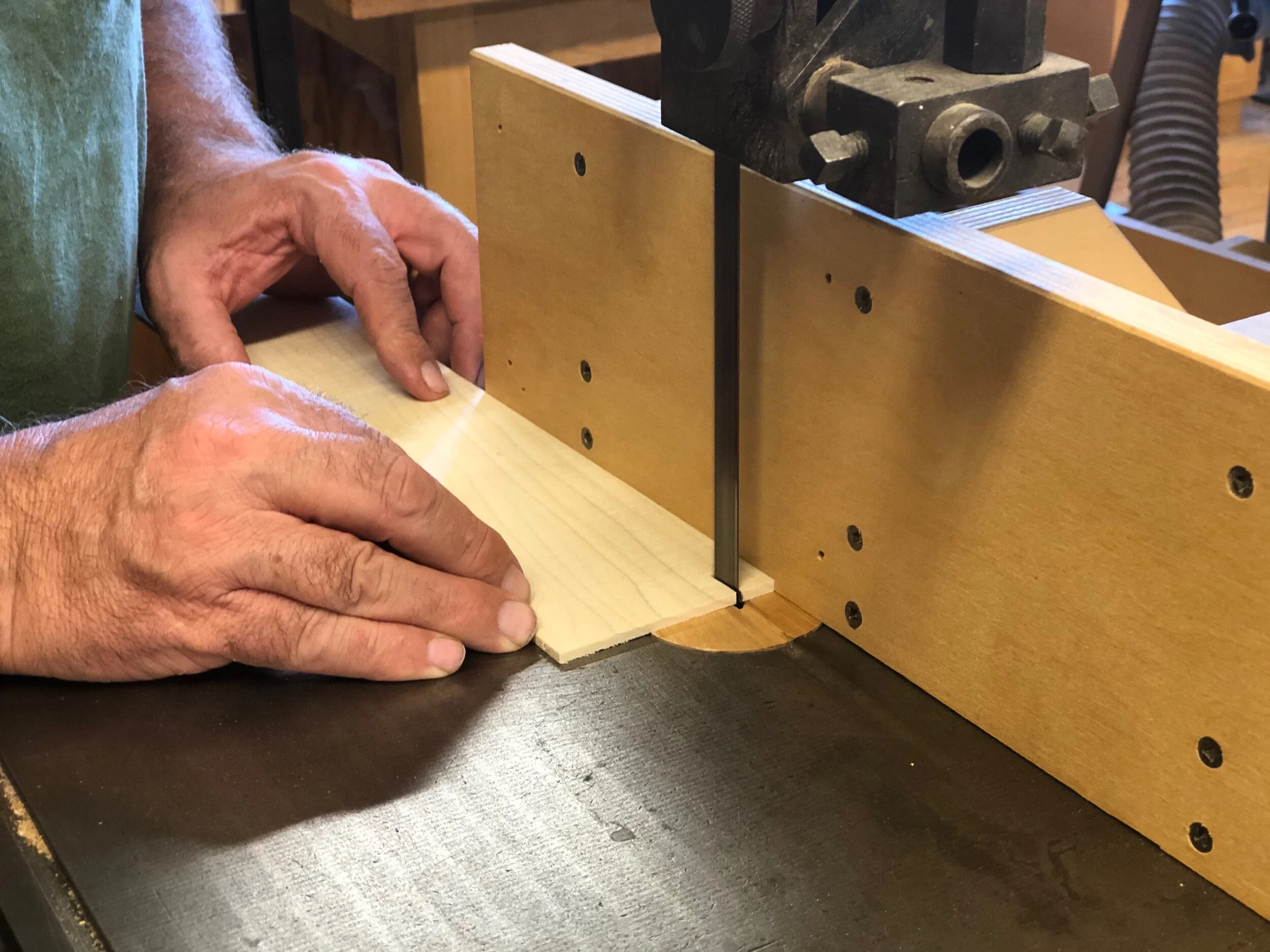
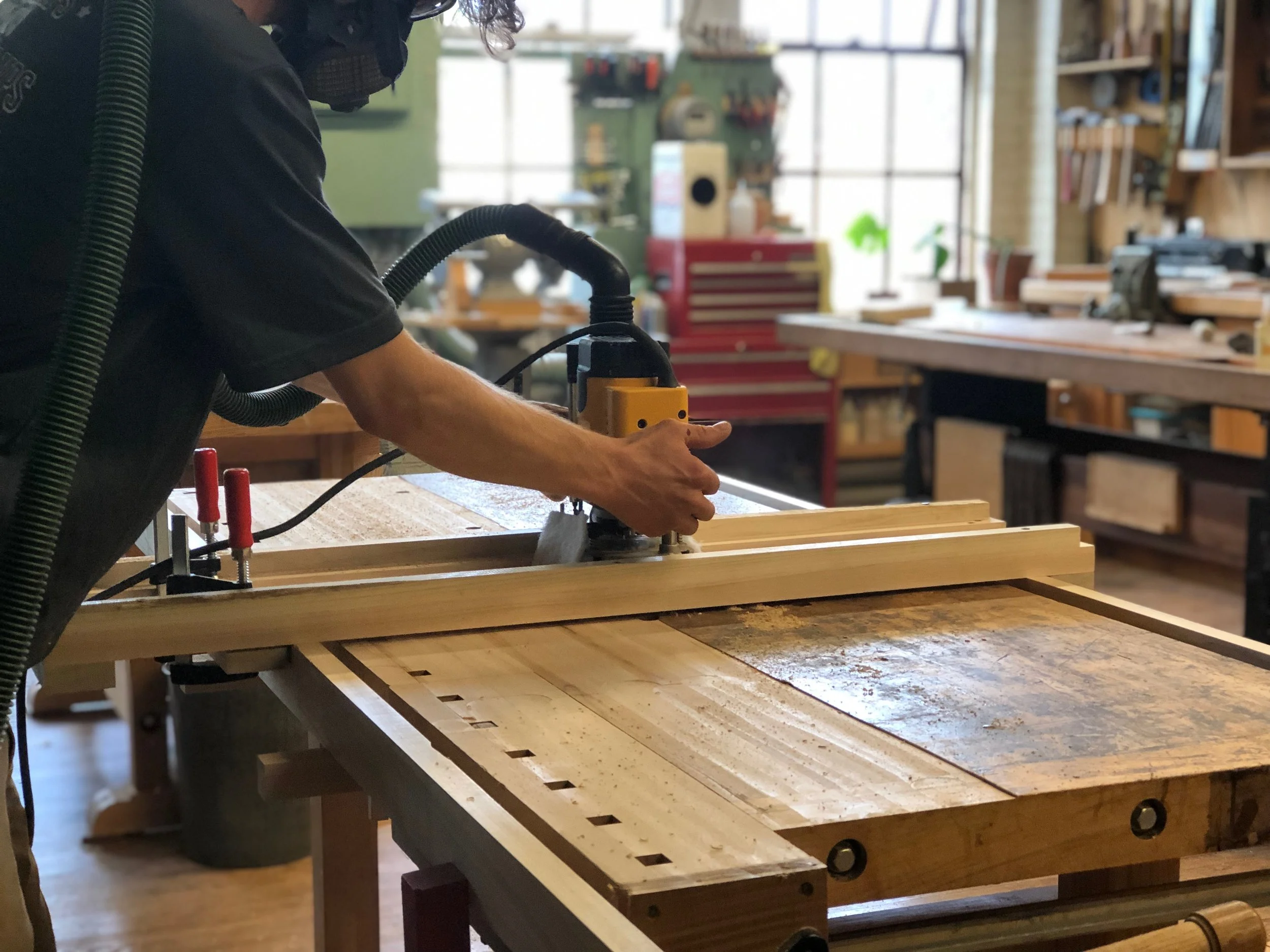
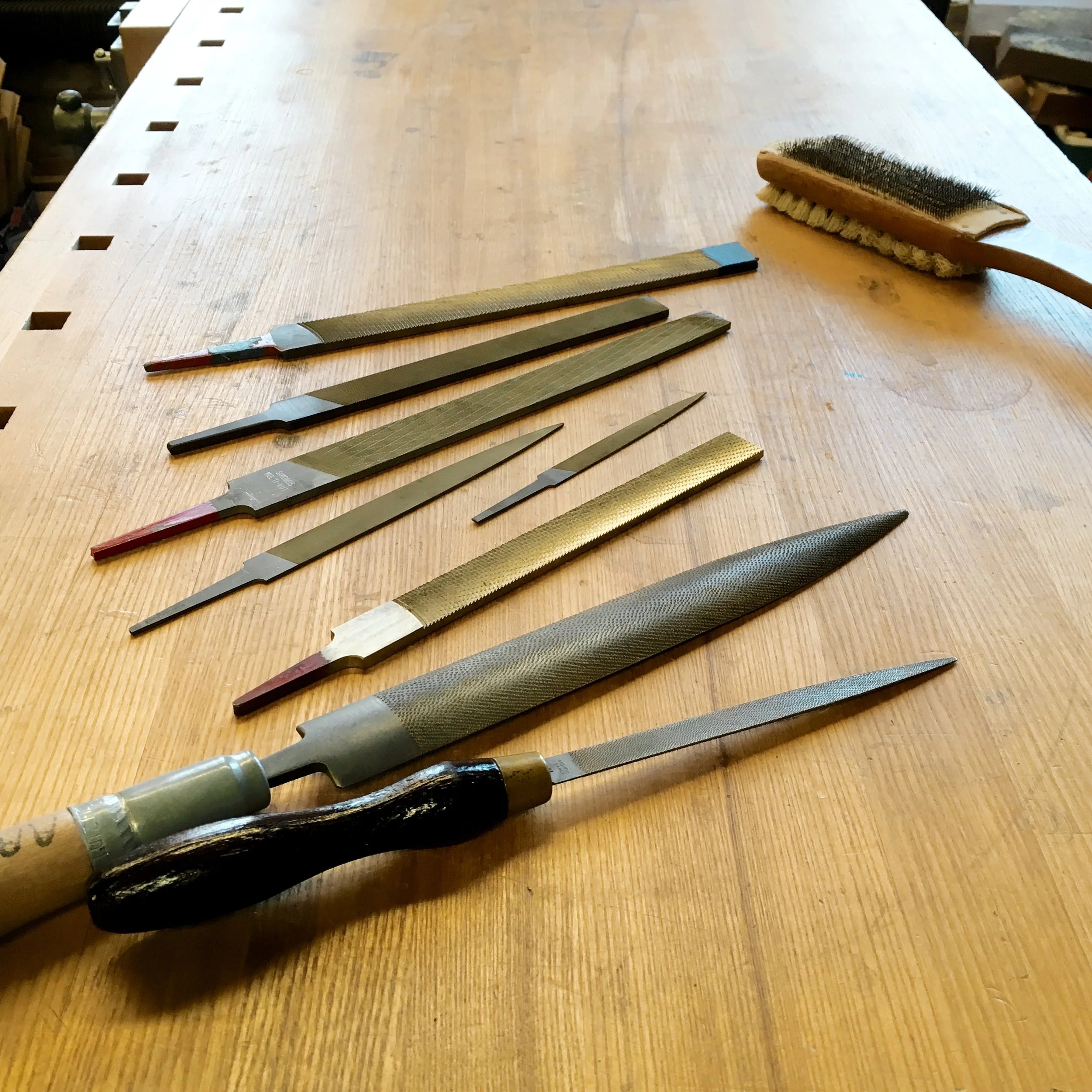
I just completed my re-design of the Thomas Jefferson Lap Desk for a PFW Master Class. This is a pretty cool project. The whole thing is about the size of a small laptop computer; practically the same size as the original l8th century desk. (More to follow in future blog entries on the construction of the desk)
The original desk was made by Benjamin Randolph, a Philadelphia furnituremaker, as a portable desk that could also be used as a book rest and to store writing supplies. It was made of mahogany.
Before building my version, I consulted Lon Schleining’s article, written for FWW in 2001, on his copy of the desk made for the Smithsonian. He did a masterful job dealing with several cross grain issues and problems that plagued the original, which I believe was executed upon a hasty request and an urgent need. At the time it was built, I don’t think either Jefferson or Randolph imagined the desk would survive or that it would ever achieve any historic importance.
Lately I’ve been constructing backdrops to better showcase our workshop projects. I think shooting furniture in a period context makes for a more effective- and beautiful presentation. Sometimes people’s imaginations need a little nudge and seeing a piece in a realistic setting and not against a monochromatic seamless background makes a stronger case.
Once the Jefferson lap desk was completed, I wanted to get a shot of it for the website. I could have cooked up a period backdrop; a worn table top pushed against a faux paneled wall; illuminated by a flickering candle and accessorized with an assortment of table top antiques. Then I thought of my friends Dave and Carol Spacht. Some of you might remember Dave (of Spacht’s Sawmill) as the subject of a short Taunton video on boutique sawmills. To this day, it’s one of Taunton’s most popular video offerings.
Carol, who is in charge of school tours for Dave’s sawmill, works at the Betsy Ross House as a Betsy Ross interpreter. Well, the original desk was made right here in Philadelphia, so what better place to photograph my copy.
I contacted Carol to ask about access to the house and she didn’t anticipate any trouble, but had to go through channels first. She got back to me within a couple of days with a green light. Alan and I assured Carol, and the curator, that we wouldn’t be dragging a load of equipment, cables, lights, or screens; just an SLR digital camera on a tripod and the lap desk. We also mentioned that we had some experience handling historic antique objects; to assure her she wasn’t letting “a pair of bulls into her china shop”.
The curator, archivist, and staff at the house all possess advanced degrees and/or special training in the conservation of antiques, to include: furniture, paintings, paper, glass, metal, and fabrics. Their cardinal rule is: Don’t disturb anything, if you can help it! Dust, excessive light, traffic, and the careless handling of objects all contribute to the premature demise of these precious artifacts. Public tours, maintenance and cleaning, and historical research are all carefully conducted in order to manage the inevitable aging of the objects. If something must be moved, it’s always lifted with two hands. Lighted candles or open flames of any kind are prohibited. Even the intrusion of sunlight is controlled and minimized with low voltage lighting, window blinds, and UV filters. All these precautions are taken while providing access to over 250,000 visitors each year.
Good thing we traveled light. The small and narrow Betsy Ross house, built in 1740, is 2 stories tall with a basement; it’s only 2 rooms deep, and has a tight winding staircase running the height of the building. Standing, huddled in one of the upstairs bedrooms, we hardly had room to turn around. And when I started maneuvering for a good camera angle, it became more than a little tricky.
I wanted to showcase the desk, perched beside Betsy Ross and steeped in early American ambiance. My plan was for the desk to be in the foreground with Betsy seated behind it, in the shadows and slightly obscured. This was a difficult shot because to achieve the desired effect, I needed to establish the proper distance between Betsy and the desk; which didn’t leave much room to maneuver with a camera and tripod. And there were technical factors, such as camera shutter speed, aperture, and ISO to be managed. All the while, small groups of tourists, students, and house staff were filing by, peeking in, asking questions. Pressed against a chest of drawers while maintaining my precarious balance, I framed the image in the viewfinder, held my breath, and took one shot, and then another, and another . . . .
Through all this – and more – Betsy was patient and cooperative; willing to pose any number of ways: holding the flag up, letting it down, draping it across her lap, taking a stitch, holding perfectly still, head up, then down; and all this while keeping in character.
After the shoot, our last stop was a visit to Betsy’s workshop, where she held a room of visitors spellbound. We stood quietly in the back of the small shop and watched her at work. Carol Spacht was something. She is the real thing; trained in theater, Carol is also an accomplished writer and a die-hard history buff. This Christmas she received an antique sewing bird and a copy of the latest G. Washington biography as gifts. She even commutes to work in costume. When addressing visitors, Carol strives to “catch a sense of the period” and works to “open doors of discussion”, often engaging visitors in a dialogue. If you ever catch her interpretation of Betsy Ross, you’ll know it’s not just a job for her.
Just before we left the house, Carol spoke about Betsy’s suggestion (to Washington) to use a 5-pointed star on the flag instead of one with 6 points. Betsy’s reasoning: it was simply easier. As a demonstration, Carol first folded a small paper square several times into a tight triangle; then made a single scissor cut. When she unfolded the piece, there was a perfect 5-pointed star; a very impressive finale. Thank you, Betsy.
Mario


Great post. I’ve never been to the Betsy Ross house but am now inspired to go!
Great post. I was checking continuously this blog and I am impressed! Extremely useful information specially the remaining part
I care for such info a lot. I used to be seeking this certain info for a very long time. Thank you and good luck.